
Vue Smart Glasses
All Products
Eyeglasses
Sunglasses
Accessories
Vue Lite 3
How It Works
Lenses
Vue App
FSA, HSA & Insurance
About
Contact
Explore Top Picks Find a Store
0%

Choosing the China Best Blue Light Blocking Smart Glasses Manufacturers requires more than comparing prices or polished product photos. Buyers need evidence, technical understanding, and practical experience.

This guide explores manufacturers producing Blue Light Blocking Smart Glasses for work, travel, gaming, and everyday screen use. It considers lens performance, frame comfort, battery life, Bluetooth stability, app support, and production consistency. A reliable supplier should explain its testing methods clearly. It should also provide material details, quality-control procedures, and documented compliance for target markets.

Small details matter. A comfortable frame should not press behind the ears after several hours. The lenses should reduce selected blue-light wavelengths without creating distracting color distortion. Charging contacts should remain stable after repeated use. These points sound simple. They often are not.

Manufacturer assessments also include factory experience, engineering capability, communication speed, sample quality, and after-sales support. Third-party testing can strengthen confidence, but certificates alone cannot prove daily performance. Independent samples and batch inspections remain valuable.

There is no universal “best” manufacturer. A supplier suitable for a premium healthcare brand may not fit a budget retail project. Some factories appear highly capable during sampling, yet struggle with large-volume consistency. That risk deserves honest attention.

The following overview presents leading Chinese manufacturers through a practical, evidence-based lens. It highlights strengths, limitations, and questions buyers should ask before signing a purchase agreement. Claims should be verified. Expectations should be realistic. Even experienced buyers can overlook firmware updates, packaging accuracy, or replacement-part availability.
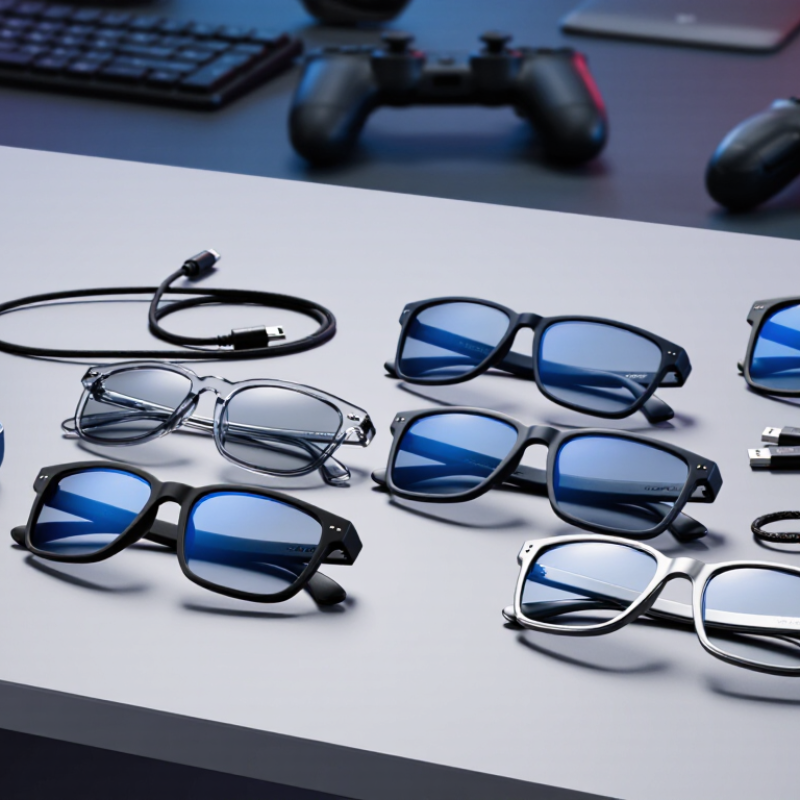
China Best Blue Light Blocking Smart Glasses Manufacturers

Definition and Core Functions of Blue Light Blocking Smart Glasses

Blue light blocking smart glasses are wearable optical devices designed to filter selected high-energy visible light while supporting digital functions. Their lenses may use a tinted coating, a clear filter, or layered optical materials. The blocking range differs between models, so manufacturers should provide measured wavelength data instead of broad marketing claims.

Core functions can include screen viewing, hands-free notifications, voice control, audio playback, and basic environmental sensing. Some designs adjust lens transmission as indoor lighting changes. Useful performance depends on more than filtering. Optical clarity, color accuracy, frame pressure, battery life, heat control, and stable wireless connections also matter. In professional testing, independent transmission reports and impact-resistance records offer stronger evidence than appearance alone. A darker lens is not automatically better.

Tips: Check the tested wavelength range and visible-light transmission. Wear the glasses for short sessions first. Watch for eye strain, color changes, or nose pressure. Smart glasses should support comfort, not replace regular breaks or qualified eye care. Manufacturers should also explain charging limits, privacy controls, and repair options in clear language. Evidence on blue-light filtering remains mixed, especially for long-term eye-health claims, so careful wording is important. Some features may sound impressive but feel unnecessary after daily use.

China Best Blue Light Blocking Smart Glasses Manufacturers

Definition and Core Functions of Blue Light Blocking Smart Glasses

Blue light blocking smart glasses combine optical filtering with electronic features such as display integration, sensors, audio, connectivity, and prescription-lens support. The chart presents the approximate wavelength width of commonly referenced spectral bands; it is a scientific classification, not a measurement of any specific product’s filtering performance.

Wavelength ranges are approximate: ultraviolet-A is 315–400 nm, violet is 400–455 nm, blue-turquoise is 455–500 nm, and green is 500–570 nm. Blue-light definitions vary by optical standard and application.

Key Technologies Used by Leading Chinese Manufacturers

China’s leading smart-glasses manufacturers combine optical engineering with compact electronic design. Their lenses commonly use selective filtering to reduce specific blue-light wavelengths. This approach is more precise than simply making lenses dark. Many factories test transmission curves with spectrometers, checking visible light from roughly 400 to 700 nanometers. Results should include actual measurement data, not only marketing claims. The strongest suppliers also control ultraviolet protection and lens clarity during production.

Smart features depend on efficient components. Miniature sensors can adjust tint when indoor brightness changes or sunlight reaches the user’s eyes. Some models use electrochromic lenses, while others use layered optical films. Low-power processors support notifications, audio controls, and basic health-related functions. Battery design matters. A thin frame still needs stable charging contacts and heat control near the temples. Poor weight distribution becomes uncomfortable after several hours.

Manufacturers increasingly use anti-reflective coatings to reduce screen glare and nighttime reflections. They also improve hinge durability through repeated opening tests and temperature checks. However, no filter removes every visual discomfort. Blue light is only one possible factor in eye fatigue. Lens color, prescription accuracy, screen distance, and blinking habits also matter. One weakness remains: performance can vary between batches if coating thickness is not monitored carefully. Buyers should request independent test reports, coating specifications, battery-cycle data, and clear guidance for prescription customization.

China Best Blue Light Blocking Smart Glasses Manufacturers - Key Technologies Used by Leading Chinese Manufacturers

Technical specifications shown are representative industry practices and may vary by model, optical architecture, and testing method.
Technology Area Typical Technical Data How It Supports Blue-Light Management Common Validation Method Manufacturing Consideration
Selective lens filtration Targeted attenuation commonly focuses on portions of the approximately 400–500 nm visible-light range. Reduces transmission of selected short-wavelength visible light while preserving usable color and display brightness. Spectrophotometer measurement of spectral transmittance across approximately 380–780 nm. The filter curve must be matched to the display spectrum and the intended visual color balance.
Substrate-embedded pigments Absorbing additives are incorporated into the lens material rather than applied only as a surface layer. Provides more uniform filtration through the lens and can improve resistance to surface wear. Transmission mapping, colorimetry, haze testing, and accelerated aging evaluation. Pigment concentration must be controlled to avoid excessive color distortion or reduced optical clarity.
Anti-reflective coating Multilayer dielectric coatings are used to reduce reflections on one or both lens surfaces. Limits reflected glare and improves perceived contrast for camera-assisted and display-based eyewear. Front- and back-surface reflectance measurement over the visible spectrum. Coating adhesion, abrasion resistance, humidity resistance, and color neutrality are key quality controls.
Hard coat and scratch protection A protective hard coat is commonly applied to polymer lenses before additional optical coatings. Preserves optical performance by reducing scratches that can scatter light and create glare. Abrasion, adhesion, chemical-resistance, and surface-defect inspections. Coating compatibility is important when the lens includes embedded filters, conductive films, or display optics.
Micro-display integration Smart-glasses architectures may use micro-OLED, micro-LED, or LCOS display engines, depending on design requirements. The optical filter must be selected according to the display’s emitted spectrum so that blue-light reduction does not excessively affect image quality. Display spectral measurement, luminance testing, color-gamut testing, and image-quality evaluation. Mechanical alignment and thermal management influence optical uniformity and long-term reliability.
Waveguide or combiner optics Optical waveguides, birdbath combiners, and prism-based systems are used to place digital images in the user’s field of view. Enables digital content to be combined with the wearer’s real-world view while allowing spectral filtering in the optical path. Field-of-view, eyebox, distortion, stray-light, transmittance, and image-uniformity tests. Filter placement must not create excessive ghost images, chromatic aberration, or reduced see-through visibility.
Adaptive tint control Electrochromic or liquid-crystal elements can alter lens tint or transmission when electronically controlled. Allows transmission and glare levels to be adjusted for different lighting environments; it is not automatically equivalent to blue-light blocking. Switching-time, cycle-life, spectral-transmission, power-consumption, and uniformity tests. The control system must maintain safe visibility and prevent noticeable tint mismatch between the two lenses.
UV protection layer Quality eyewear commonly targets ultraviolet attenuation through approximately 400 nm, subject to the applicable product standard. Provides ultraviolet protection, which is separate from filtering visible blue light in the 400–500 nm region. UV–visible spectrophotometry and applicable sunglass or personal-eye-protection standard testing. UV claims should be supported by batch-level test records and clearly separated from blue-light claims.
Photobiological safety Assessment considers optical radiation exposure from LEDs, displays, illumination sources, and other emitters. Helps evaluate whether the integrated display and lighting system presents an acceptable optical-radiation risk under intended use. Risk assessment based on IEC 62471 or relevant product-specific safety requirements. Testing should cover normal operation, maximum brightness, fault conditions, and foreseeable user distance.
Optical and production quality control Typical controls include lens power, prism, haze, transmittance, color difference, dimensional accuracy, and electronic function checks. Maintains consistent visual performance and ensures that blue-light filtering remains within the approved design window. Incoming-material inspection, in-process sampling, final inspection, reliability testing, and traceable test documentation. A controlled spectral-transmission specification is essential for consistent results across production batches.

How to Evaluate Lens Quality, Smart Features, and User Comfort

When evaluating China’s best blue light blocking smart glasses manufacturers, start with measurable lens quality. Ask for the filtering curve, not only a percentage claim. A reliable supplier should show how much blue light is reduced across specific wavelengths. Check visible-light transmission, color distortion, coating durability, and ultraviolet protection separately. A sample viewed beside a white screen can reveal unwanted yellow tint. It is useful, but not laboratory proof.

Smart features should solve real problems. Test voice controls in a quiet room and near ordinary street noise. Check connection stability, microphone clarity, speaker leakage, charging time, and battery performance during continuous use. Confirm whether firmware updates are documented and whether user data receives clear protection. Factory audits, material records, and independent test reports add authority. However, paperwork cannot replace hands-on testing. I once trusted a polished specification sheet too quickly.

Comfort decides whether people wear the glasses after the first week. Measure frame weight, bridge pressure, temple tension, lens balance, and heat near the electronics. Wear the sample for two hours, then inspect skin marks and pressure behind the ears. Prescription compatibility matters for many users. Hinges should open smoothly without feeling loose. Small details matter. A slightly heavy frame may seem acceptable in a showroom, yet become irritating during a long commute. My testing is not perfect, so feedback from different face shapes should influence the final evaluation.

Major Manufacturing Standards, Certifications, and Quality Controls

China Best Blue Light Blocking Smart Glasses Manufacturers

Reliable manufacturers of blue light blocking smart glasses build quality around recognized standards, not marketing claims. ISO 9001 supports documented production and corrective actions, while IEC 62368-1 addresses electrical and audio-visual equipment safety. EMC testing helps confirm that wireless functions do not create harmful interference. Depending on the destination market, products may also require RoHS, REACH, CE, UKCA, or FCC compliance. These marks should match the actual product and test scope. A certificate alone proves little.

Optical performance needs measurable evidence. Factories should test lens transmission with calibrated spectrophotometers across relevant wavelengths, especially the claimed blue-light range. They should record batch numbers, coating thickness, color shift, and protective performance. Incoming inspections can check lenses, frames, batteries, chips, and charging parts before assembly. Production checks should include hinge strength, charging safety, wireless stability, sweat resistance, and drop performance. Final inspectors should verify optical consistency, touch controls, packaging, and user instructions.

Details matter.

A trustworthy supplier can provide dated reports, calibration records, sampling plans, and traceability from component to shipment. However, no factory is flawless. Coatings may wear faster than expected, and comfort can vary between users. Manufacturers should review complaints, repeat failed tests, and update designs rather than hide weak results. Independent laboratory verification is valuable when claims involve eye comfort, filtering rates, or long-term durability.

Applications, Customization Options, and Global Supply Capabilities

China’s blue light blocking smart glasses manufacturers serve offices, classrooms, clinics, and digital workspaces. Employees may use them during long screen sessions, while students need lightweight frames for extended study. Field technicians can combine heads-up information with hands-free communication. The application changes the optical and electronic design.

Experienced manufacturers usually offer customized lens filtering, frame geometry, temple colors, and prescription compatibility. Buyers can also request adjustable brightness, voice control, gesture functions, and multilingual firmware. Battery capacity matters. So does comfort. A frame that feels heavy after ten minutes may fail during a full workday. Lens testing should measure transmission, color distortion, glare, and visual clarity under different lighting conditions. Not every blue light claim is equally useful. Results need documented test methods and clear performance data.

Global supply capability depends on more than factory size. Reliable suppliers coordinate optical design, PCB assembly, injection molding, firmware validation, packaging, and final inspection. They should support prototypes, small pilot orders, and scalable production. Export teams need accurate documentation and stable communication across time zones. Quality checks should include hinge strength, charging safety, Bluetooth stability, and batch consistency. Some prototypes look impressive but remain uncomfortable or difficult to repair. That weakness deserves honest review. Regional service partners, spare parts, and traceable production records can reduce delays for international buyers.

FAQS

Which standards can support smart glasses quality?

ISO 9001 supports documented processes and corrective actions. Electrical safety testing should match the product type. EMC testing checks wireless interference. Destination markets may require additional compliance documents. A certificate alone proves little.

How should manufacturers test blue-light filtering performance?

They should use calibrated spectrophotometers across relevant wavelengths. Reports should show transmission rates, test methods, and batch numbers. Color shift and visual clarity also deserve measurement. Claims without data need caution.

What inspections should happen before assembly?

Incoming inspections should check lenses, frames, batteries, chips, and charging parts. Inspectors should record defects and supplier batches. Small components can create large failures.

Which production tests matter for finished glasses?

Testing should include hinge strength, charging safety, wireless stability, sweat resistance, and drop performance. Final checks should verify touch controls, optical consistency, packaging, and instructions. Repeated testing is necessary.

What customization options are commonly available?

Buyers may request lens filtering, frame geometry, temple colors, and prescription compatibility. Other options include brightness control, voice functions, gestures, and multilingual firmware. Customization can increase testing needs.

How can buyers judge comfort for long screen sessions?

They should review frame weight, balance, nose support, and temple pressure. A frame may feel fine for ten minutes but tiring after hours. Comfort varies between users. That uncertainty should not be ignored.

What information should a reliable supplier provide?

A reliable supplier should provide dated reports, calibration records, sampling plans, and traceability records. Documentation should connect components with shipments. Clear communication across time zones also matters.

Can a large factory guarantee reliable global supply?

Factory size alone cannot guarantee consistent delivery or quality. Suppliers should coordinate optical design, electronics, molding, firmware, packaging, and final inspection. Prototypes may look impressive yet remain hard to repair. That weakness deserves honest review.

Why are pilot orders useful?

Small pilot orders reveal comfort problems, coating wear, charging issues, and batch inconsistency. They also test communication and packaging. Some weaknesses appear only during daily use. That can be uncomfortable, but useful.

Conclusion

Blue Light Blocking Smart Glasses combine specialized lenses that filter selected blue-light wavelengths with intelligent features such as Bluetooth connectivity, audio support, activity reminders, and mobile app integration. Leading Chinese manufacturers typically focus on optical coating technology, lightweight frame design, efficient power systems, touch or voice controls, and reliable wireless performance. When evaluating these products, buyers should consider lens filtering accuracy, optical clarity, color balance, battery life, smart functions, wearing comfort, and long-term durability.

Manufacturing quality is supported by controlled production processes, material traceability, safety testing, and relevant international certifications. Quality checks may cover lens consistency, frame strength, electronic reliability, charging safety, and final product inspection. These glasses can be customized for different users and markets through lens types, frame styles, colors, packaging, software functions, and prescription options. With scalable production, private-label support, and export experience, Chinese manufacturers can provide flexible global supply solutions for retailers, distributors, corporate programs, and technology-focused product lines.

Amelia

Amelia

Amelia is a professional marketing specialist dedicated to helping businesses understand products, markets, and customer needs more clearly. With a strong command of the company’s product portfolio, industry trends, and practical applications, she creates informative and engaging content that......